Graphlaa – Universal Graph Runtime (UGR)
Any data, any format, any source. One universal graph compiler, one Graph IR, one runtime. 8 core components from raw ingestion to agent-powered reasoning.
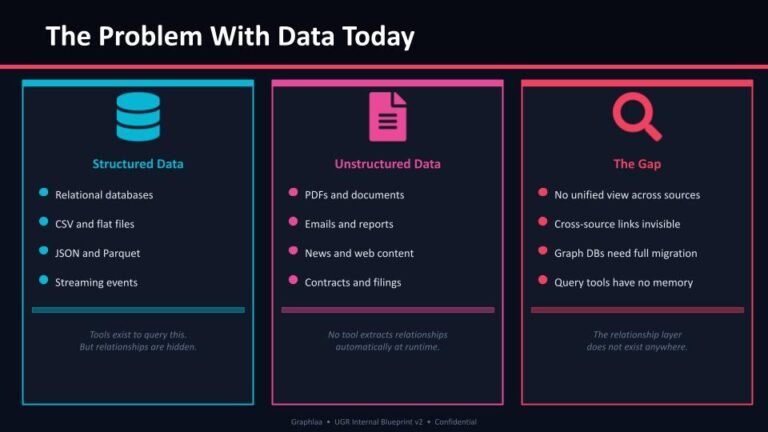
Every data tool is specialised. Relational tools query tables but cannot see cross-source relationships. Unstructured tools extract text but lose structure. Graph databases need full migration before a single query can run. There is no tool that automatically extracts the relationship layer from any data at runtime. The relationship layer simply does not exist anywhere.
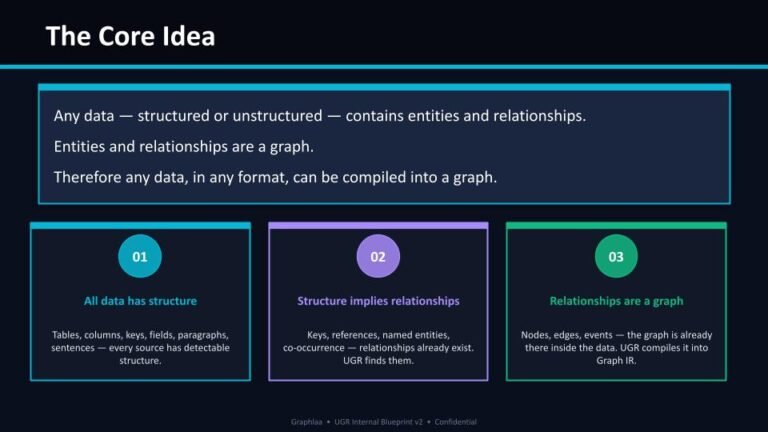
Any data, structured or unstructured, contains entities and relationships. Entities and relationships are a graph. Therefore any data, in any format, can be compiled into a graph. UGR proves this: one universal compiler, one Graph IR, one runtime, any engine.
— Rahul Bachina
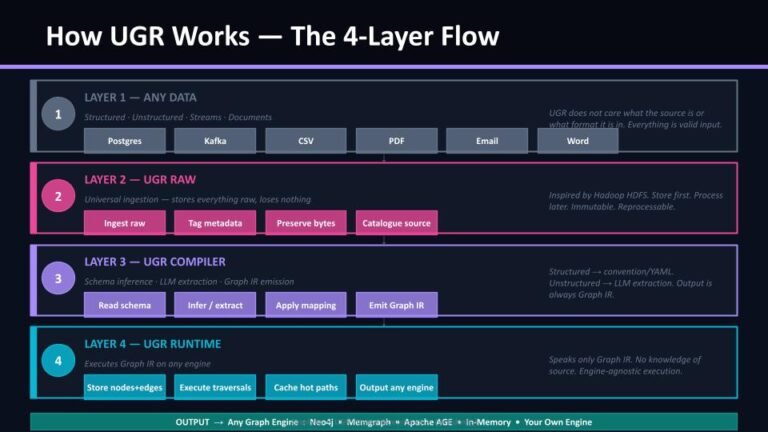
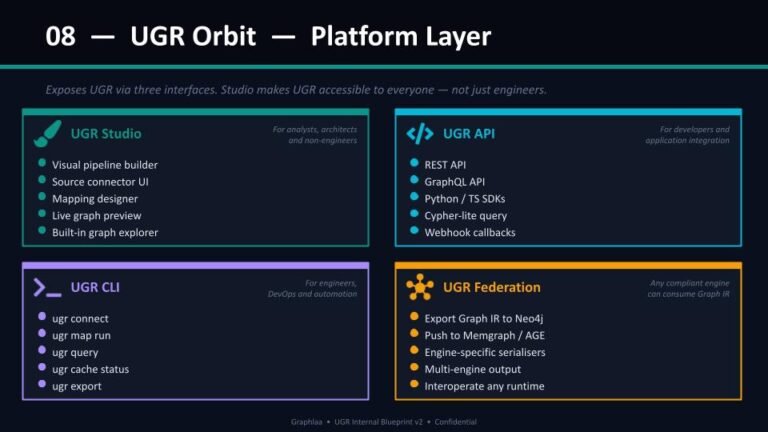
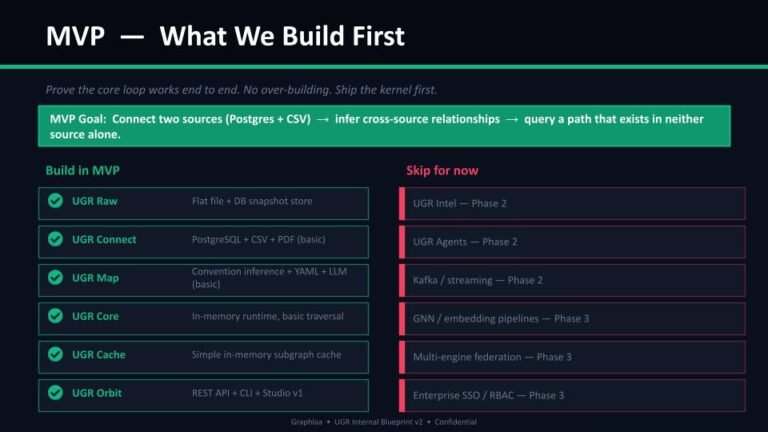
UGR is not a graph database. It is a universal compiler and runtime. 8 components: UGR Raw (HDFS-inspired immutable ingestion), Connect (multi-source adapters), Map (YAML + LLM schema inference), Core (in-memory runtime), Cache (subgraph + query result cache), Intel (embeddings, risk scores, anomaly detection), Agents (evidence-citing reasoning agents), Orbit (Studio visual builder + REST/GraphQL API + CLI). MVP: connect Postgres + CSV, infer cross-source relationships, query a path that exists in neither source alone.
- Engine-agnostic: outputs to Neo4j, Memgraph, AGE, or any compliant engine
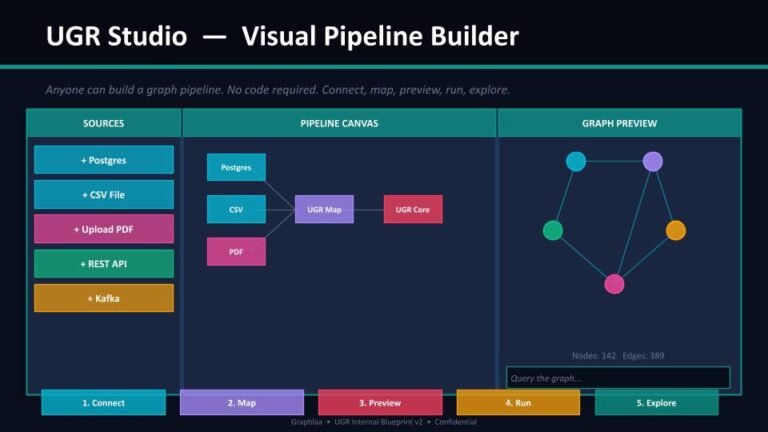
- UGR Studio visual pipeline builder requires zero code
- 8 core components from raw immutable ingestion to agent-powered reasoning
- Not a graph database: no migration required, query the relationship layer at runtime
- Anomaly detection, risk scoring, and embedding-powered entity resolution in the Intel layer
- LLM-powered schema inference maps unstructured data to Graph IR automatically



Want to collaborate or learn more?
Reach out to discuss this project, a partnership, or a new idea.
Get in Touch